

Sankanac CSA

Sankanac CSA is our biodynamic 10-acre garden, located in Camphill Village Kimberton Hills. The heart of our garden is our CSA membership, which stands for Community Supported Agriculture. The CSA model includes shareholders who make an investment at the start of the growing season to receive their portion of the harvest each week. Our shares consist of a diverse selection of vegetables that change throughout the season, reflecting what is at its peak ripeness and quality. We also offer u-pick opportunities to our CSA members including sugar snap peas, strawberries, green beans, cherry tomatoes and cut flowers.
Our 2026 vegetable shares are picked up for 24 weeks of our growing season from late May to November. Members may choose to pick-up on Tuesdays or Fridays from 12:00pm to 6:00pm.
The first pick up will be Tuesday, May 26th or Friday, May 29th.
We offer three share sizes (full, partial and mini) to suit the needs of different households. In the interest of making our CSA vegetables accessible to all members of our community we also offer sliding scale pricing. Here are some guidelines when considering the different price levels:
Consider paying more when:
Earn above the Chester County median income of $118K household or $52K individual
Own a home
Have retirements, investments or inherited money
Have access to family money and resources in times of need
Consider paying less when:
Earn below the Chester County median income of $118K household or $52K individual
Are supporting children or other dependents
Have significant debt
Have medical expenses not covered by insurance
Have a fixed income or receive public assistance
*Referencing the sliding scale model at Green Things Farm Collective in Ann Arbor, MI.
We are happy to offer naturally leavened, wood fired bread and baked goods from Sweetwater Bakery and artisan cheeses from our own Kimberton Hills Dairy as options that can be added to your weekly share. Please note that bakery shares are offered for 19 weeks to allow for the bakery to take a few weeks off. Any questions about bakery products can be sent to sweetwaterkimberton@yahoo.com.
New this year!! We will have eggs for sale at the CSA pick ups from our pastured laying hens.
If you would like to pay by check, we request that you pay for the entirety of your share after signing up. If you would like to pay by credit card, you have the option of using Paypal to pay in full, two installments, or six installments.
Please email us at sankanaccsa@gmail.com with any questions.
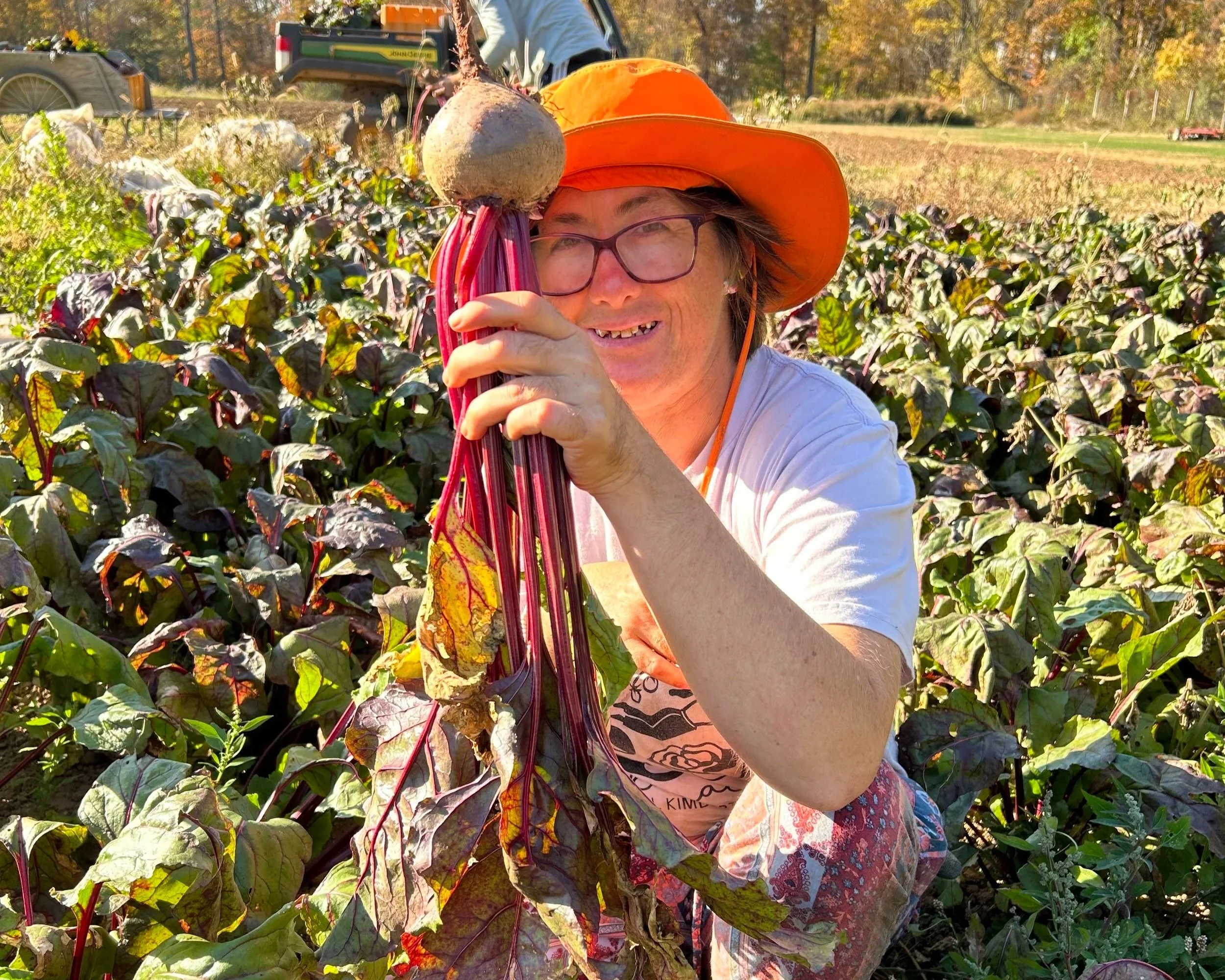
Sonia picking beets in the CSA garden.
This season we are also offering several work share opportunities to consider in exchange for a full share membership
Workshare members commit to 3.5 hours per week
WORKDAYS ARE RAIN OR SHINE, WITH FEW EXCEPTIONS. Please plan accordingly and dress for the weather. Transportation to and from the farm is your responsibility. This is a season-long commitment; however, if you need to be away for a few weeks, we can make arrangements.
Below are the different ways you can contribute in exchange for a CSA share for the season:
Harvesting / Washing Vegetables
• Monday or Thursday mornings 8:30 a.m to 12:00 p.m
Mowing / Weed Whacking
• Flexible days
• Must be done on a non-rainy day
Market Managing
• Tuesday: 3:00–6:30 p.m.
• Friday: 11:30 a.m.–3:00 p.m. or 3:00–6:30 p.m.
Duties include setting up the market, welcoming members, answering questions, keeping the market well stocked, cleaning and maintaining the bathroom, washing empty totes as they become available, cleaning the market area, and putting away vegetables at the end of the market.
Landscaping Support
• Help maintain flower beds in front of the CSA building and around the garden
• Knowledge of flowers and landscaping plants is required
• Any morning of the week
For a $100 discount, you may also volunteer for 10 hours total during the season, as needed, with various tasks. We will contact you a few days in advance when help is required. If you are unable to complete the 10 hours by the end of the season, the remaining balance on your CSA share will be due.
Please email sankanaccsa@gmail.com with interest for workshares or if you have any questions or difficulties during the sign-up process.

Diversity in People, Crops and Methods
We are deeply committed to the use of biodynamic methods, which allow us to strengthen our ecosystem while providing food of the highest nutritional value to our local community. Our crew is comprised of people of many different abilities who all live and work as volunteers at Camphill Village Kimberton Hills. Some crew members participate in the gardening season more fully with an agricultural apprenticeship. Our apprenticeship is primarily hands on education with opportunities for study and conferences in the off season.
Activities in the CSA include the following: plant propagation, greenhouse management, pruning, transplanting, weeding, harvesting and post-harvest handling of crops. Other activities are tractor and equipment operation and maintenance, irrigation, cover cropping, and making and using the biodynamic preparations. We also integrate methods to reduce the tillage of our soil to encourage soil structure rich in organic matter, beneficial insect populations and resiliency during weather events. Incorporating training and education on biodynamic farming into our daily tasks is an essential element of our garden. We help alongside people of many different abilities, backgrounds, and ages, who all find meaningful work in our garden.
Rhythm of the season
Our growing season begins in early February. We grow transplants from seed and start early crops in our greenhouses. In March, we move on to the outside garden work, cover crops, clear the straw away from the strawberries, and plant the first crops. April and May are spent cultivating the fields, transplanting the seedlings that were grown in the greenhouses, along with weeding and trellising many of the crops.
By the beginning of June, we’ve begun harvesting, and the CSA begins for the season. As fall arrives we are making the biodynamic preparations, finishing the harvest and cover cropping the fields. November brings the main summer season to a close with storage crops harvested for the winter months. Winter brings a time of reflection as we plan and prepare for the season ahead, fix tools, maintain fence lines and make infrastructure improvements.
