

Elias Rive: A Camphill Kimberton Origin Story from Helen Zipperlen’s Journal
Helen Zipperlen was one of the founding Coworkers at Camphill Village Kimberton Hills, and a major presence in the formative and ensuing years. What follows was recovered from a journal penned by Helen, written as Camphill prepared for its 40th anniversary in which she celebrates the story of Elias Rive, who lived at CVKH for decades before relocating to Camphill Hudson.
When Camphill began, people with “mental retardation” were not part of “society;” children were not educated, there were no life-choices beyond aging parents or large, inhuman, invisible institutions.
Camphill’s biography has accompanied the huge changes we know as “deinstitutionalization” and the “right to Education,” alongside larger ideas like “self determination,” “normalization,” and “inclusion.”
Huge bureaucracies have grown up to protect and support vulnerable people. Much money flows through public and private channels as ideas change and experience grows.
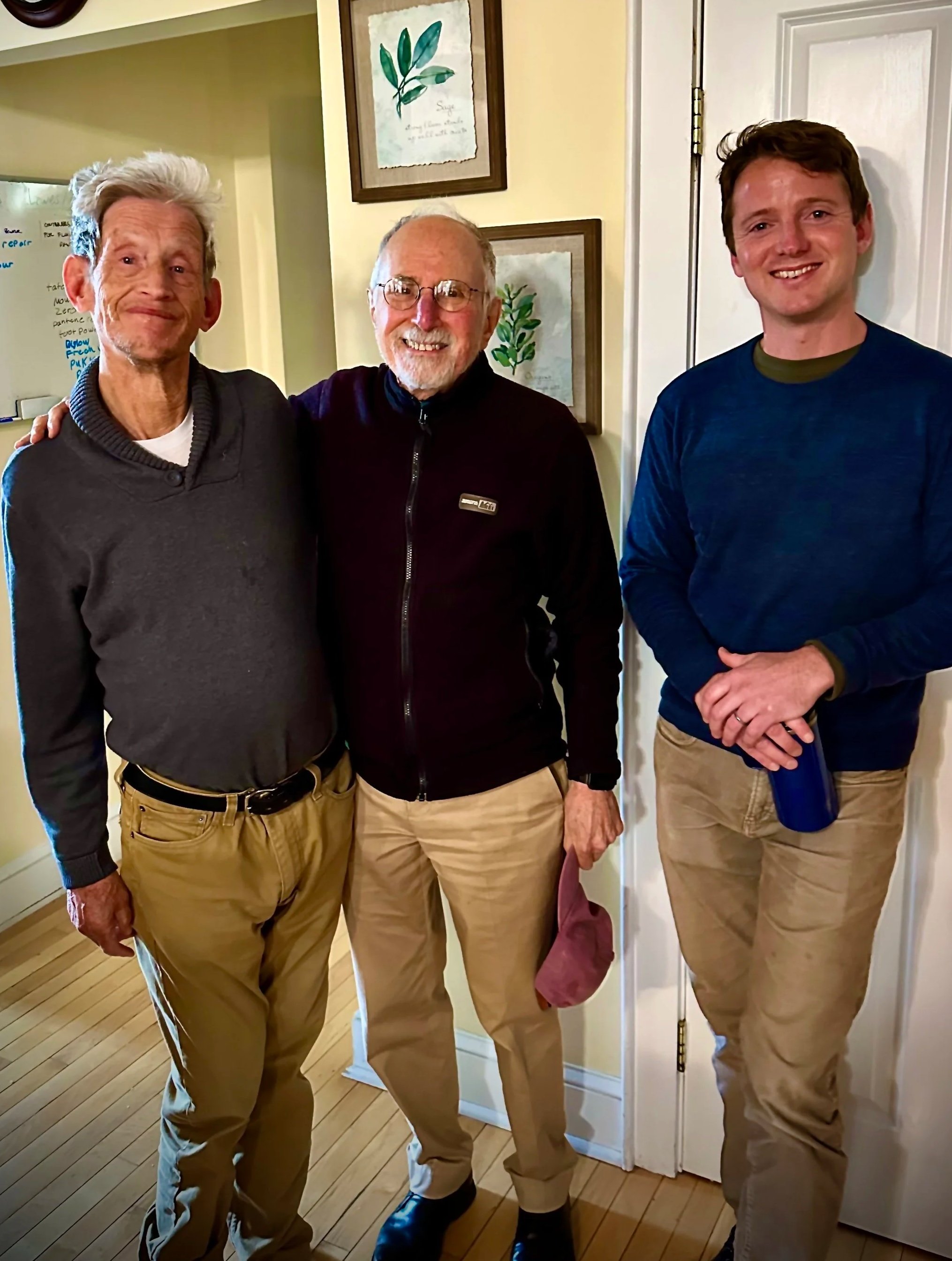
(L to R) Elias, Bob Martin, and Billy Shannon at Camphill Hudson in 2023.
Camphill schools educated the “ineducable,” eschewing concepts like “IQ” and “mental age.” When the children grew up, Camphill employed the “unemployable” by evolving a social organism in which a disability did not prevent one from making one’s contribution.
Continuous wrestling with practical problems and ideas like “normal,” “handicapped,” “responsibility,” and “risk” have been enriched and enlivened by Anthroposophy, a true science of the Human.
Especially during the ‘80s and ‘90s, Camphill was involved with a wave of remarkable people and organizations responding to the new perception of the “handicapped” and “retarded” as human beings. People first – people with disabilities. Never again should they be warehoused for their protection and the convenience of the “normal.” We are all part of the human community.
* * * * *
The implications were profound and largely unforeseen. Simply closing the institutions, sending all children to school, and making sidewalks, buses, and public buildings wheelchair accessible were not enough. This army of vulnerable, hitherto largely invisible people raised awareness and questioning of the whole idea of community.
Volumes of wisdom have been written. Perhaps here we only need a few words to involve the huge change of social ideas, the new look at community freedom: independent living, equality, self-determination, dignity of risk, working for a living, right to work, experiences, brotherhood, choice, caretakers, friends, advocacy, life-sharing.
Camphill Villages were sometimes seen as “institutions.” After all, the percentage of “disabled” was higher than the “general community.” There was a Two-Class culture of “Villagers” and “Co-workers,” embodied in comments such as “Villagers walk, Co-workers drive,” “Co-workers can travel or move away, Villagers are stuck,” and “Villagers pay to live there – Co-workers do not”
In Elias Rive’s story many of the myths and compromises can be looked at through the reality of one person.
* * * * *
What I remember about Elias Rive
Elias is Canadian. He has a sister, Edie Jane. I knew his mother slightly. His father was Canadian Ambassador to Ireland. I know nothing else about him!
Lias, and Penny Baring should tell more (Penny came to Camphill Copake on her way to the funeral of Lias’ father. Dramatic story.)
The Ambassador sent his 12-year-old(?) son Elias to Glencraig, Belfast Ireland, then one of Camphill’s earliest “colonies,” and the only one in Ireland. Lias learned farming there and turned his “speech impediment” into his own unique and original eloquence.
When Copake began [1961], his family wanted Lias to be closer to his Canadian home (where that is, exactly, I don’t know). He was not in the very first wave, but a fairly early Copaker (I got there first, not by much). He became a farmer, with Hartmut, Leetze, and Asger Elmquist.
Those were the years of “conscientious objectors” coming for two years to Copake. Many of these young men talked of their intention to be farmers. Several promised Lias that he could come work with them making their own small farm.
I was rather deeply moved by Lias’ disappointment whenever one of these dreams evaporated (promises broken?). It was not that he disliked Camphill life — he was not only a responsible, caring farm worker, but he also took part in the home and cultural life. But the dream of having his “own little farm” and the normal wish to explore the world were real and strong in him.
So when Kimberton Hills appeared [1972], and the decision was taken that Hubert and I should go there from Copake to join Andrew, Herta, and family, we immediately thought of Lias. We lived in Hickory House. Lias, next door in Rock Maple with Irene Robson.
“Hey Lias, Hubert and I are going to a new place — a farm in Pennsylvania — want to come?”
“YyyyUP!”
So we prepared to arrive on November 15, 1972. Copake lent us a station wagon (with one snow tire) into which we loaded all three lives. Nov 14, Hubert was pretty much immobilized with lumbago [acute low back pain]. Lias loaded, ran errands, remembered details. And it snowed. Hard. With Hubert prone on a mattress, we pulled out early on the Taconic Parkway, skidding a bit, but there was curiously little traffic. At the southern exit we saw why: a big sign read “Taconic Parkway Closed.” Just Lias’ ticket, though he didn’t have to use the shovel he’d remembered to load! We made it to Beaver Run, and next morning the five of us, with four young Hoys, took over Kimberton Hills. Hoys in Kepler, Lias and Zipperlens in Garden Cottage (the only empty houses on the estate).
* * * * *
1973 began a time of social and physical changes.
The Glenmede Trust operated the estates of recently deceased Alarik and Mabel Myrin. For us, the critical “go-to” person was Florence Duke, with her office in the main building of Kimberton Waldorf School. She administered the affairs of all the Myrin employees who had been told of Camphill’s coming only days before it happened. The Estate was divided between Camphill and the Waldorf School by French Creek.
So these people found themselves employed by one of these organizations, often while living in houses owned by the other. For us, this meant the houses now known as Franklin, Farmhouse Linden (horseman’s apartment for the Stable, now Sycamore) Gatehouse, Oberlin, Springfield, Hyacinth, Sankanac, Lilac, and Kerria — the chauffer’s apartment above the garage. Of these, Franklin, Oberlin, and Sankanac were duplex, i.e., 12 families were either our employees or our tenants. Mrs. Duke’s wisdom and cheerful efficiency helped each and all as decisions were made to stay awhile, leave at once, stay with Camphill... Howard and Georgia Good and their youngest, Clyde, opted to stay with the Guernsey cows in Farmhouse. Jim Brady stayed a year in Kerria apartment. Neil Nyce stayed a year in Linden. Gerald and Jean Sollinger stayed in half of Sankanac, and their son Jerry in Hyacinth.
The attitudes of all these folk was understandably wary as they found out gradually what a Camphill Village might be. Some, including Howard Good the farmer, knew about Beaver Run and its children and expected children here to be cared for as he cared for his cows.
Howard’s position: “Me and my men, we run the farm. If you need a calf to show to your kiddies, tell me. Otherwise, leave us be.” He had run the farm pretty independently during Mr. Myrin’s illness, building up a herd of show-class Guernsey cows by methods far from the Biodynamic dreams of Pfeiffer and Myrin.
Similarly, went the rest of the land. Woodlands were left alone. Orchard consisted of the piece above Sycamore/Sassafras and below Kepler/Kerria. Apple trees were pruned back annually to same place, giving the trees a curious aspect — like many clenched fists — sprayed with chemicals.
The greenhouse had been the province of Mr. McGowan, who died shortly before we came. It grew flowers and houseplants. Gerald and Jerry Sollinger carried on the routines, while caring for all the non-farm land mostly by mowing (eight acres, carefully manicured), and some planting of ornamentals (Gerald’s love for lilacs, e.g.) The slope between Greenhouse and Gooseberry was mowed and set up each spring with boards on which the potted tropicals were set out.
Gerald and Jerry were “Estate Crew,” with Ed Stringer, a slightly eccentric veteran living in Springfield. They, unlike Howard Good, turned soon for direction to Hubert Zipperlen, whom Gerald called “The Mister.”
This was the first merging between past tradition and the newcomers — when Lias spent a day working with Gerald, Jerry, and Ed. They said “He’s good,” and the long friendship began.
* * * * *
Gerald and Lias
Gerald was immensely strong, digging post holes and creating fences, working with tiny cuttings and seedlings, transplanting a shrub in full flower, driving the old greenhouse truck full of trash and old machinery to “down back,” the steep slope below Larkspur (graveyard of civilization preceding the dumpster era).
Lias was the perfect “right hand man.” One thing he could do which Gerald could not was read and write. Gerald would sow seeds, give Lias the packet and some labels, on which Lias would inscribe “trademark,” or “Burpee,” or “Ziploc,” or “cut here,” or (sometimes) the name of the seed.
But the great bond was fishing: both were enthusiasts, Gerald highly skilled. Evenings, they’d be on French Creek behind Sankanac. Weekends, Gerald would drive them “up the mountains” (I never found out exactly where). Jerry too was a fisherman, and skilled in “poaching” the then plentiful pheasants (grain soaked in whiskey!). Lias was at home in both families, opening the way for others who joined us later (Eliof Budd, Otto Porst, Michael Weinstock, and Bill Lewis).
As the social thaw continued, Howard Good one day showed Hubert the ridge between Pipeline, Orchard, and Garden Cottage/Oberlin. He hardly ever used it — we can have it!
Garden Cottage Barn was empty, also the Stable and Sankanac barn, full of old hay, mousy grain surplus stuff. I said “we need a pig.” Andrew said “we’ll get a whole lot of them.” Lias said, “Let’s have a pig farm.”
* * * * *
Hubert, born in Stuttgart, knew the exact slope and airflows for a vineyard. Gerald threw up the fences in a jiffy.
Lias and Hubert went looking for good pigs in the old green truck. They lived in Garden Cottage Barn along with some chickens. Overflow population went into the old stable, in the horse pens, the indignity of which caused Neil Nyce to leave.
So architect Walter Leicht was called again (first conversion was Kerria, second Sycamore).
Gerald and his crew cut a track through the jungle from Garden Cottage Barn to Oberlin and fenced off a field for pigs (Pig I and II). Sows needed better “nurseries.” Hubert taught a young volunteer (and future Waldorf teacher) how to build — block and cement — later converted to Gooseberry.
Endless, hilarious pig tales — Lias lived it all — sharing Garden Cottage with us and lots of others (always 6–8, before any of the additions). Otto Porst loved especially the cats and chickens, learning enough that Ross Church’s father gave him a job, living in rooms above his veterinarian office on Rte. 202 in King of Prussia. Eliot Budd came for a vacation from Copake and decided to stay long-term because, “I like them lady cows.”
* * * * *
The “Deinstitutionalization” Era
Pennhurst had over 3,000 inmates when we came — our nearest institution.
Copake had a huge waiting list. Beaver Run graduated a dozen youngsters annually. Carlo Pietzner addressed a gathering of parents. “We cannot provide enough villages for all; please help us imagine and create places and opportunities of all kinds.”
Endless tales of the responses.
John Mott’s parents and family Swerling
“Village House” in Kimberton
Family Braden – from Louisiana to 12 Oaks, Spring City
Lou Chapman
“Egress Acres”
Joyce Reilly and the beginning of Gheel House
Bill Knowles
Earle and Norene Beuton
Ruth Wood (Chester County ARC) and Bill McKendry (Chester County Administrator for MR) These two great people had a remarkable cooperation. They knew Beaver Run, and when they heard that a Camphill for adults would come, they travelled to Copake to see what that might mean. Their wisdom, knowledge, and friendship — a book in itself!
* * * * *
Ruth’s Residential Services Committee of ARC also sought solutions for Chester County folks with MR and asked one of us from Kimberton Hills to join them. I went, and learned ever so much. We met in the home of Debbie Smith, who later sent her Molly to Beaver Run. Ruth also brought to the Committee a newly arrived staff member of Embreeville: Ray Shanahan.
All the people mentioned above — and many, many more — began focusing their continuous discussions in a monthly meeting, rotating around each other’s homes. Out of this grew “Orion Communities, Inc” A great history!
* * * * *
Much of this buzzing activity whirled through Garden Cottage. There were frequent lunch and supper guests — announced or not — though the eight family members were enough for the table). Sometimes there were piglets in a box, or orphan chicks, and the squirrel found in the barn — 2" long and cold — who grew up to run Garden Cottage as she pleased. Ruth Wood tactfully remarked “It has the used look of a farmhouse.” I thought that such a kind way to describe our cluttered hurly burly.
Lias took it all in stride, friendly and ever helpful. He took little part in the mealtime discussions, unless fishing was mentioned. One day Jonathon Collinson dropped in. He was a keen Orion participant, wanting to make a home with people, wanting to make a home with wife Margaret (Brinton) and children, and wanting to farm. Orion had a “rule” that members should be within a 15 minute drive, so we could be truly mutually supportive. But Jonathon could find no affordable land in Chester county. That summer day he came to report that he had found THE place. He found it on Ascension Day and now it’s a done deal — but a good 40 minutes drive.
Lias and I were doing the dishes together when he suddenly remarked, “That young man Jonathon was interesting. I shall go and take a look — and if I like what I do see, I may become his Right Hand Man.”
And so it was! Lias and Nina Ossi spent several years at Ascension Farm, building it up from a sadly derelict little place, helped by Orion work days and other support.
Like many Orion families, the Collinsons eventually moved North (interesting phenomenon — no obvious common reason why). At that point Elias decided to return to Copake.
“I am retired. Now I only work on the farm five days a week.”
Next part would come from Copake/Hudson about the genesis of Camphill Hudson and Lias and friends’ decision to create it.
Someone could, over time, get Lias to tell his own stories, perhaps prompted by the above (or correcting my memories)
* * * * *
Odd Thoughts
When we look at Camphill today, and at other life-sharing communities, we see what “people with disabilities” have brought about through their apparent vulnerability and need. This can become a pious cliché.
So also can the experience, “They are my teachers.”
We do tend to celebrate, and rightly, leaders, board members, donors, co-workers, etc.
Today, in this country at least, we experience a mood of re-institutionalization, (only the buildings/places are smaller). Kimberton Hills might have stuff to offer.
What would the picture be if we could see the story of all the people with disabilities who have passed through Kimberton Hills and where to and where now?